
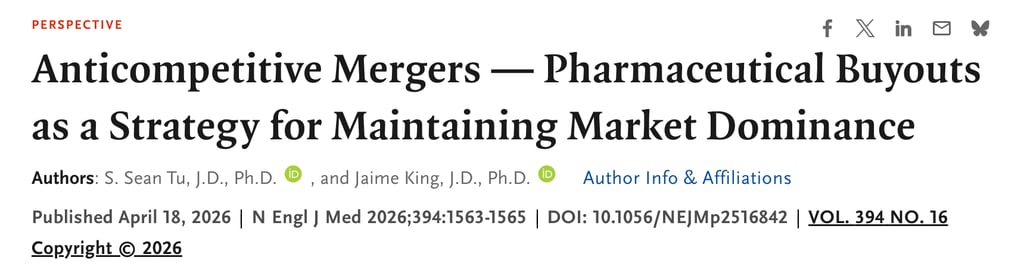
A recent perspective in the New England Journal of Medicine makes a sharp argument: pharmaceutical mergers, particularly "killer acquisitions" in which an incumbent buys a smaller competitor and shelves its products, are eroding competition and harming patients. The authors call for tighter antitrust screening, lower notification thresholds for pharma deals, and a rebuttable presumption against acquisitions involving overlapping products.
The diagnosis is largely correct. The proposed treatment, in 2026, may be the wrong dose at the wrong time.
What the NEJM piece does not fully reckon with is the funding environment small biotechs are actually operating in. That environment changes, which deals are predatory, which are pragmatic, and which proposed reforms would help patients, versus quietly accelerate the death of the assets they are meant to protect.
The case the NEJM authors make
The argument is built on a few well-chosen examples and a piece of empirical research worth taking seriously.
The 2012 Covidien acquisition of Newport Medical Instruments is the rhetorical anchor. Newport was developing a ventilator priced around $3,000, against incumbent products closer to $10,000, and was on track for a 40,000-unit federal contract. Covidien acquired the company, canceled the contract, and shut the ventilator business down. The Department of Justice opened an investigation in 2020, after Covid-era shortages made the consequences impossible to ignore.
The more recent example is Novo Nordisk's attempted acquisition of Metsera, a GLP-1 receptor agonist developer. The deal was structured in two steps, using nonvoting shares and special dividends that drained Metsera's assets, with the formal merger and transfer of voting shares deferred until years later. The structure appeared engineered to slip under Hart-Scott-Rodino reporting thresholds while giving Novo Nordisk de facto control over a potential competitor's pipeline. Metsera ultimately merged with Pfizer instead, a buyer with no approved obesity drug and therefore every incentive to bring the assets to market quickly. Novo Nordisk's involvement in the bidding raised Pfizer's purchase price by roughly $2.7 billion.
The empirical backbone comes from research showing that pharmaceutical projects acquired by firms with overlapping products are 20.9% more likely to have development halted post-acquisition than those acquired by firms without overlap. Separately, non-reportable pharma deals are three times more likely than reportable ones to involve consolidation of overlapping projects.
From this, the authors propose a package of reforms: lower HSR thresholds for concentrated industries like pharma, inclusion of intangible assets such as patents in size-of-person valuations, a rebuttable presumption against overlapping-product mergers, mandatory development plans, annual milestone reporting, and independent monitoring of acquired pipelines.
Each of these has merit on its own terms. The trouble is that they assume a market that no longer exists.
The funding picture the NEJM piece sidesteps
Crunchbase data tells a story the antitrust framing does not. In 2025, biotech's share of US startup investment fell to roughly 8% — the lowest in more than 20 years of Crunchbase tracking. Historically the figure has sat between 15% and 20%, and during the 2020 surge it approached 20%. Only $8.2 billion went into US biotech seed and early-stage rounds for the entire year. Through late September 2025, just 18 US biotech, drug-discovery, and medical-device companies had completed IPOs, putting the year on pace to be one of the worst on record.
This is not a cyclical dip. It is a structural reallocation of capital toward AI, occurring at the same time as a series of policy shocks specific to life sciences:
Cuts to NIH and other public research funding, which thins the academic-to-startup pipeline.
Leadership instability at the FDA and HHS, which compresses the implied probability of regulatory milestones being hit on schedule — the single largest input into any biotech valuation.
Tariff uncertainty is affecting CDMO and API supply chains, which complicates capex planning for any company without an established manufacturing footprint.
Unresolved drug-pricing policy, including expansion of IRA negotiation and ongoing noise around most-favored-nation pricing.
For a Series B biotech burning $3–5 million a month with a Phase 2 readout 18 months out, "wait for better market conditions" is not a strategy. It is a slow-motion bankruptcy. In this environment, M&A is frequently not a choice between an independent path and an acquisition. It is a choice between an acquisition and the asset dying in a Chapter 7 auction, where it may be bought for pennies, stripped for parts, or never developed at all.
That counterfactual matters, because it is the one the NEJM authors quietly assume away.
Where the proposed reforms hold up, and where they bite
Looking at each proposal against this backdrop produces a more uneven verdict than the NEJM piece suggests.
Rebuttable presumption against overlapping-product mergers. This sounds reasonable until you ask who the natural buyers are for a small GLP-1, oncology, or immunology biotech. They are the companies with the scientific expertise, manufacturing infrastructure, regulatory experience, and global commercial reach to actually finish development, which by definition means firms with overlapping portfolios. A presumption against these acquirers does not eliminate the buyer pool, but it shrinks it and shifts it toward firms that may be slower or less capable. Some assets that would have been advanced under an overlapping acquirer will instead languish under a less competent one, or simply not find a buyer at the price needed to clear the cap table. The patients waiting for those therapies do not benefit.
Lower HSR thresholds for pharma specifically. Catching more killer acquisitions has obvious appeal. But HSR review is not free. Legal, economic, and compliance costs for a notified deal routinely run $1–5 million and can extend timelines by six to twelve months. For a distressed biotech with eight months of runway, that cost and delay can be the difference between a deal closing and the company filing for bankruptcy before the closing date. Lowering thresholds catches more bad deals and kills more good ones in roughly equal measure, with no obvious way to tell them apart ex ante.
Including intangible assets in size-of-person valuations. This one survives the funding-crunch critique cleanly. Most pharmaceutical companies' real value sits in their patents, and excluding intangibles from size-of-person tests is the loophole that makes structures like the Novo-Metsera two-step possible. Counting intangibles closes that gap without categorically blocking transactions or imposing new burdens on ordinary small-biotech M&A. It targets evasion rather than discouraging legitimate deals. This is the highest-value reform in the package.
Annual milestone reporting and independent monitoring as a condition of approval. This is the most attractive structural option in a capital-starved market. It lets deals close — founders get liquidity, employees keep jobs, assets get funded — while creating an accountability mechanism if the acquirer attempts to shelve the asset. The reporting cost is real but manageable, and it scales with the size of the acquired pipeline. Compared to a hard presumption against overlapping deals, it preserves optionality on both sides.
The pattern that emerges is that the NEJM proposals targeting structural evasion — closing the intangibles loophole, scrutinizing two-step structures designed to dodge review, requiring transparency post-close (hold up well under the current market, the proposals targeting the act of merging itself ), presumptions, lower thresholds — are blunter instruments that risk doing meaningful damage to a sector already under severe capital stress.
The Novo-Metsera caveat
The funding-crunch argument should not be allowed to absolve everything. The two-step structure described in the NEJM piece (nonvoting shares, special dividends draining the target's assets, formal merger, and voting transfer deferred years into the future) is qualitatively different from a normal distressed-biotech acquisition.
A standard small-biotech sale is a transparent transaction in which the acquirer pays a price, the target's shareholders are bought out, and the deal is reviewed against existing thresholds. A two-step structure engineered specifically to dodge HSR review while transferring de facto operational control over a competitor's pipeline is not a survival mechanism. It is a regulatory arbitrage. The funding environment is a reason to be careful about reforms that raise the cost of ordinary deals. It is not a reason to ignore deal structures that are designed to be invisible to regulators.
This is why the strongest version of the reform package targets structural evasion specifically: the intangibles loophole, two-step dodges, and post-close opacity. These reforms catch the Novo-Metsera-style transactions without imposing new friction on the small biotech that simply needs to sell to survive.
A more honest framing
The NEJM authors frame mergers primarily as a predator problem. The 2025–26 funding environment reframes a meaningful share of these deals as a survival problem. Both framings are partly correct, and they apply to different transactions in different proportions.
The policy question is not whether killer acquisitions exist. They do. The question is whether the proposed remedies can distinguish between a Novo Nordisk-style structural maneuver and a Series B biotech with eight months of runway selling to the only credible buyer in its therapeutic area. The remedies that can make that distinction are worth pursuing. The remedies that cannot will reduce the supply of completed therapies in roughly the same way the killer acquisitions they target do, just through a different mechanism.
For founders, investors, and policymakers thinking about this in real time, the practical synthesis is reasonably clear. Close the structural loopholes aggressively. Require transparency in pipeline development post-close. Be cautious about anything that raises the cost or uncertainty of ordinary small-biotech M&A in a market where acquisition is increasingly the only path that gets a therapy to patients at all.
The goal of antitrust policy in healthcare is not the absence of mergers. It is the presence of treatments. Reforms should be measured against that standard, not against an idealized counterfactual in which every promising small biotech can finish development on its own. In 2026, that counterfactual is a story we tell ourselves. The companies, the assets, and the patients live in a different one.
The Killer Acquisition Problem Looks Different When the Money Runs Out
© 2026. All rights reserved.
Bridging science, innovation & capital
COMPANY
SUPPORT
CONNECT