
Lab-grown meat sounds like science fiction. Plant-based burgers feel suspiciously engineered. And conventional meat? Well, that's just… meat. But what if our gut instincts about which is safest are exactly backwards?
If you ask the average shopper which meat product carries the highest cancer risk, you'll likely hear concerns about "Frankenmeat" grown in bioreactors, or warnings about the long ingredient lists on plant-based burgers. Conventional meat — the steak, the bacon, the chicken breast — usually escapes scrutiny entirely. It's familiar. It's traditional. It's "natural."
The science tells a very different story.
A comprehensive review of the peer-reviewed literature, regulatory assessments, and institutional reports reveals that conventional meat — particularly as produced in the United States — carries the most well-documented carcinogenic risks of any meat category on the market. Lab-grown and plant-based alternatives, despite their futuristic image, present substantially lower demonstrated hazards.
Here's what the evidence actually shows.
Three Very Different Ways to Make a Burger
Before weighing risks, it helps to understand how each product gets to your plate.
Conventional meat in the US largely comes from Concentrated Animal Feeding Operations (CAFOs). According to the USDA, roughly 88% of growing pigs receive antibiotics in their feed. Seven hormone drugs — including synthetic estrogens and testosterone — are FDA-approved for use in US livestock, typically delivered via ear implants. The European Union bans all of this outright.
Lab-grown (cultivated) meat is produced by taking a small sample of cells from a live animal via biopsy, then growing those cells in bioreactors fed an oxygen-rich nutrient broth. Over 2 to 8 weeks, the cells multiply, differentiate into muscle and fat, and are harvested. No slaughter. No antibiotics. No hormones.
Plant-based meat is built from soy, wheat gluten, or pea protein, combined with oils, binders like methylcellulose, and natural colorants. High-moisture extrusion — heat and pressure — creates the fibrous texture that mimics ground meat.
The Carcinogen Conversation Nobody Wants to Have
Here's where things get uncomfortable for the steakhouse crowd.
In 2015, the World Health Organization's International Agency for Research on Cancer (IARC) classified processed meat as a Group 1 carcinogen — the same category as tobacco smoke and asbestos. Unprocessed red meat was classified as Group 2A, a "probable" carcinogen.
Conventional meat carries cancer risk through multiple independent mechanisms:
Cooking carcinogens. High-temperature cooking of animal meat produces polycyclic aromatic hydrocarbons (PAHs) and heterocyclic amines (HCAs) — both established mutagens. One study testing retail meat for 33 carcinogenic chemicals concluded consumption should be capped at five servings per month.
Nitrosamines. The sodium nitrite and nitrate used to cure bacon, ham, and hot dogs form nitrosamines during cooking and digestion — potent carcinogens, and the primary reason for the WHO's Group 1 classification.
Hormone residues. The European Commission's Scientific Committee has flagged concerns about the genotoxicity and carcinogenicity of hormones used in US livestock. Estrogen exposure has been directly linked to breast cancer risk.
Antibiotic residues. Roughly 80% of all antibiotics sold in the US go to livestock. Roxarsone, a common factory-farm antibiotic, contains the most carcinogenic form of arsenic.
Environmental pollutants. Over 95% of human exposure to dioxins and PCBs — persistent carcinogenic pollutants — comes from animal-source foods, where they bioaccumulate over the animal's lifetime. Surprisingly, organic meat doesn't fix this; in some samples, organic meat contained higher levels of dioxins, PCBs, lead, and arsenic.
None of these mechanisms applies to lab-grown or plant-based meat.
"But Isn't Lab-Grown Meat Made of Cancer Cells?"
This is the viral claim, and it's wrong.
The confusion centers on "immortalized cell lines" — cells modified to divide indefinitely. Critics seized on this to claim that cultivated meat is essentially cancer in a petri dish.
As Elliot Swartz of the Good Food Institute put it: "All cancers are immortalized, but not all immortalized cells are cancer. Sort of like how not all rectangles are squares." Cancer requires several other characteristics — invading neighboring tissue, forming new blood vessels, uncontrolled behavior — that immortalized food cells do not have.
The FDA has been blunt: "The claim that cancer or pre-cancerous cells are used in the process of cell-cultivated food is false."
A 2023 FAO/WHO safety assessment concluded the probability of a cultivated meat cell surviving harvesting, cooking, digestion, the intestinal barrier, and immune surveillance to cause harm in a consumer is "extremely low." The agencies stated bluntly that current science "does not support the plausibility of human cancer contagion via introduction of cells even from other humans."
Cultivated meat has now been approved for sale in Singapore (2020), the United States (2023), Israel (2024), and Australia/New Zealand (2025).
What About All Those Ingredients on a Beyond Burger?
Plant-based meat's biggest reputational problem is the "ultra-processed food" label. And technically, that's accurate — nearly all commercial PBMAs qualify under the NOVA classification.
But here's the nuance: when researchers separate plant-based meat from other ultra-processed foods (sweetened beverages, processed animal meats), the negative health associations largely disappear. The massive EPIC study found no link between plant-based meat consumption and cancer or cardiometabolic disease. A 2025 analysis in Clinical Nutrition Open Science called PBMAs "the rare ultra-processed exception" — healthier than the foods they replace.
The colorants that worry consumers? Mostly natural: beet juice, annatto, paprika, lycopene. The most scrutinized — soy leghemoglobin, the "bleeding" ingredient in Impossible Burger — was shown in a comprehensive toxicology evaluation to be non-mutagenic and non-clastogenic, with no adverse effects at doses over 100 times typical human intake.
The Perception Paradox
Here's the striking part of all this — public perception of risk is essentially inverted from the evidence:
The Meat Paradox: Why the "Scariest" Meat on Your Plate Might Be the Most Familiar One
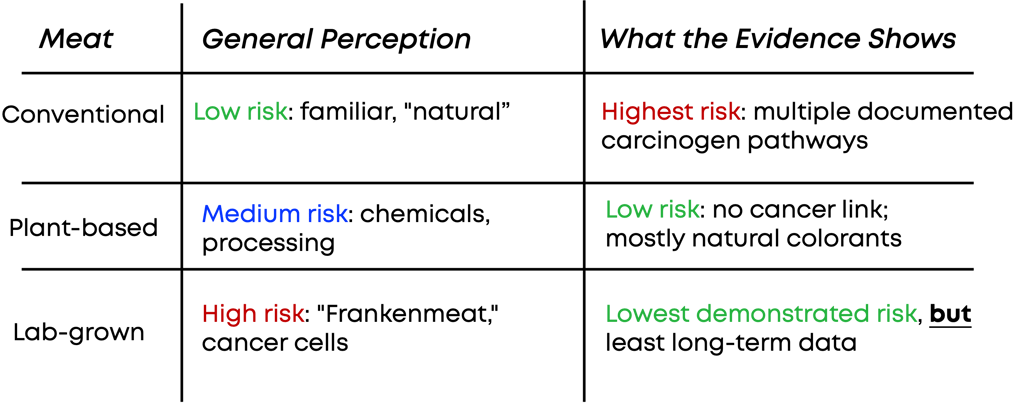
This inversion comes from well-documented cognitive biases: the naturalistic fallacy (equating "natural" with "safe"), novelty aversion (distrusting unfamiliar tech), and status quo bias (preferring what we know).
As Walter Willett, Professor of Epidemiology and Nutrition at the Harvard T.H. Chan School of Public Health, put it: "The fat composition of beef is so undesirable for health that it's very easy to be better than that."
So What Should You Actually Eat?
The honest answer: no food is perfectly safe, and the question isn't whether alternative meats are flawless — it's whether they're safer than what they're replacing.
On that question, the evidence is clear. Both lab-grown and plant-based meats represent a substantial reduction in documented carcinogenic risk compared to conventional meat — especially in the US, where regulatory permissiveness around hormones and antibiotics adds risks that European consumers don't face.
Lab-grown meat carries the lowest demonstrated risk but the least long-term data. Plant-based meat sits in the middle: low documented risk, with growing evidence behind it. Conventional meat — particularly processed cuts cooked at high heat — carries the most extensively documented cancer risks of any food on your grocery shelf.
The next time someone tells you they don't trust those "weird new meats," it might be worth gently pointing out which meat actually has the WHO carcinogen classification.
It's not the one in the bioreactor.
Bibliography
[1] Souleymani, S., Naghib, S.M., & Mozafari, M.R. (2025). Cultivated meat fabrication: A review of the latest cell biology, bioprocess technology, and tissue engineering. Trends in Food Science & Technology. ScienceDirect.
[2] Good Food Institute (2025). The science of cultivated meat. gfi.org.
[3] EUFIC (2025). Cell-based meat and other cell-based foods: how it is made and what are the pros and cons. eufic.org.
[4] Park, H. et al. (2025). Metabolomic insights of cultured meat compared to conventional meat. Scientific Reports, 15, 15668. Nature.
[5] Fraeye, I. et al. (2020). Sensorial and Nutritional Aspects of Cultured Meat in Comparison to Traditional Meat. Frontiers in Nutrition. PMC7105824.
[6] Chriki, S. & Hocquette, J. (2020). The Myth of Cultured Meat: A Review. Frontiers in Nutrition. PMC7020248.
[7] Siddiqui, S.A. et al. (2022). Cultured meat: Processing, packaging, shelf life, and consumer acceptance. LWT, 172, 114192.
[8] Souleymani, S. et al. (2024). An overview of cultured meat and stem cell bioprinting. Journal of Agriculture and Food Research, 18, 101307.
[9] Good Food Institute (2025). The nutritional profile of plant-based meat. gfi.org.
[10] Greger, M. (2025). Are ultra-processed plant-based meats better than the alternative? Clinical Nutrition Open Science, 61, 241–252.
[11] Fernández-Fígares Jiménez, M.C. & López-Moreno, M. (2025). Ultra-processed Plant Foods: Are They Worse than their Unprocessed Animal-Based Counterparts? Current Nutrition Reports, 14(1), 115.
[12] Rizzolo-Brime, L. et al. (2023). Nutritional Assessment of Plant-Based Meat Alternatives. Nutrients, 15(6), 1325. PMC10058979.
[13] Wu, H. et al. (2024). Plant-based meat analogs: color challenges and coloring agents. Food, Nutrition and Health. Springer Nature.
[14] PMC (2024). The Color-Developing Methods for Cultivated Meat and Meat Analogues: A Mini-Review. PMC11097031.
[15] Fraser, R.Z. et al. (2018). Safety Evaluation of Soy Leghemoglobin Protein Preparation. International Journal of Toxicology, 37(3), 241–262. PMID: 29642729.
[16] FDA (2025). Color Additives in Foods. fda.gov.
[17] Bacanlı, M.G. (2024). The two faces of antibiotics: an overview of the effects of antibiotic residues in foodstuffs. Archives of Toxicology, 98, 1717–1725.
[18] Hirpessa, B.B. et al. (2020). Hormones and Hormonal Anabolics: Residues in Animal Source Food. Journal of Food Quality, 5065386.
[19] PMC3834504. Risk Assessment of Growth Hormones and Antimicrobial Residues in Meat.
[20] NutritionFacts.org (2021). The Human Health Effects of Cultivated Meat: Chemical Safety.
[21] AP News (2023). Animal cells used to create lab-grown meat are not cancerous, experts say.
[22] Full Fact (2024). No evidence that lab-grown meat causes 'turbo-cancer.'
[23] Science Feedback (2023). Lab-grown meat isn't made of cancerous cells.
[24] DW (2023). Debunking myths about lab-grown meat.
[25] foodfacts.org (2025). Are we being fed cancer cells? The lab-grown meat claim fact-checked.
[26] Harvard T.H. Chan School of Public Health (2025). The bottom line on ultra-processed plant-based meat.
[27] Scientific American (2024). Are Plant-Based Ultraprocessed Foods Linked to Heart Disease?
[28] MDPI (2023). Safety and Nutritional Risks Associated with Plant-Based Meat Alternatives. Sustainability, 15(19), 14336.
[29] Bloomberg (2023). Lab-Grown Meat Has Bigger Challenges Than the FDA.
[30] PMC8584139. Immortalizing Cells for Human Consumption.
© 2026. All rights reserved.
Bridging science, innovation & capital
COMPANY
SUPPORT
CONNECT